Safari browser is no longer supported on Windows.

Consent Matters & Consent Matters Disability
Funded by the Department of Families, Fairness and Housing (DFFH) in partnership with Women’s Health in the South East (WHISE).
Following legislative changes to affirmative consent in Victoria, Sexual Health Victoria (SHV) was awarded grant funding for the Consent Matters Project.
SHV Consents was one of multiple projects funded by DFFH in 2022 with the aim of bringing awareness to this important legal and cultural shift.
Announcement – Empowering Young People to Understand Consent.
Legal changes included:
- Updated definition of consent
- Focus on how a person has asked for sexual consent
- Increased penalties for Image Based Abuse
- Acknowledgement of abuse of power in relationships
- Stealthing criminalised
- No consent if payment was agreed to and not provided
Sexual Assault Services Victoria (SASVic) summary of changes.
Consent Matters provided education to Youth and Community Workers on the legislative changes. Two Melbourne Metropolitan and one Victorian Regional workshops were delivered, and participants received two online learning modules and accessed three activities. Expert SHV educators designed the activities in collaboration from test groups of young people.
Project partners at WHISE evaluated this program. This evaluation showed that the program effectively enhanced the participants’ professional understanding of:
- The ethical and legal aspects of sexual consent.
- The new affirmative consent legislation.
- Teaching strategies about affirmative consent.
- Healthy relationships.
- Sex positive approaches to education and support.
- Trauma-informed approaches to education and support.
- Sexual health and wellbeing services for young people.
This is evidenced by the shift towards higher ratings of post-training and the sustained high ratings during follow-up. Consent Matters Evaluation.
Consent Matters Disability
After the success of Consent Matters, SHV was approved for extended funding in 2025. Recommendations from the first project included:
- Develop adaptations for working with unique groups
- Develop shorter, adaptable versions of activities
- Enhance practical content for specific settings
With these in mind, this iteration was designed to support professionals working with young people with cognitive disability – Consent Matters Disability.
With a preventative approach to sexual violence, it was designed to increase the confidence of disability support professionals and those supporting young people with a cognitive disability to provide information, support and resources needed for young people to understand and engage in healthy, consensual sexual and romantic relationships, with a focus on the affirmative consent model.
Consent Matters - Disability delivered one Melbourne Metropolitan and one Victorian Regional workshop and participants received two online learning modules and accessed three activities. The activities were designed by expert SHV educators with the flexibility for professionals to adapt it in a way that would best suit the needs of the young people they support.
Consultation of the content was through Youth Disability Advocacy Service (YDAS) and all activities were tested by Rubix Support.
Project partners at WHISE evaluated this program. Like the first iteration, this evaluation showed that the program effectively enhanced the participants’ professional understanding in a variety of ways, including
- The ethical and legal aspects of sexual consent
- The new affirmative consent legislation
- Teaching strategies about affirmative consent to young people with cognitive disability
- Sex positive approaches to education and support specifically for young people with cognitive disability
In addition, participants' application of this learning to their role was evident in the findings, as well as a range of changes to their behaviour and professional practice since completing the program.
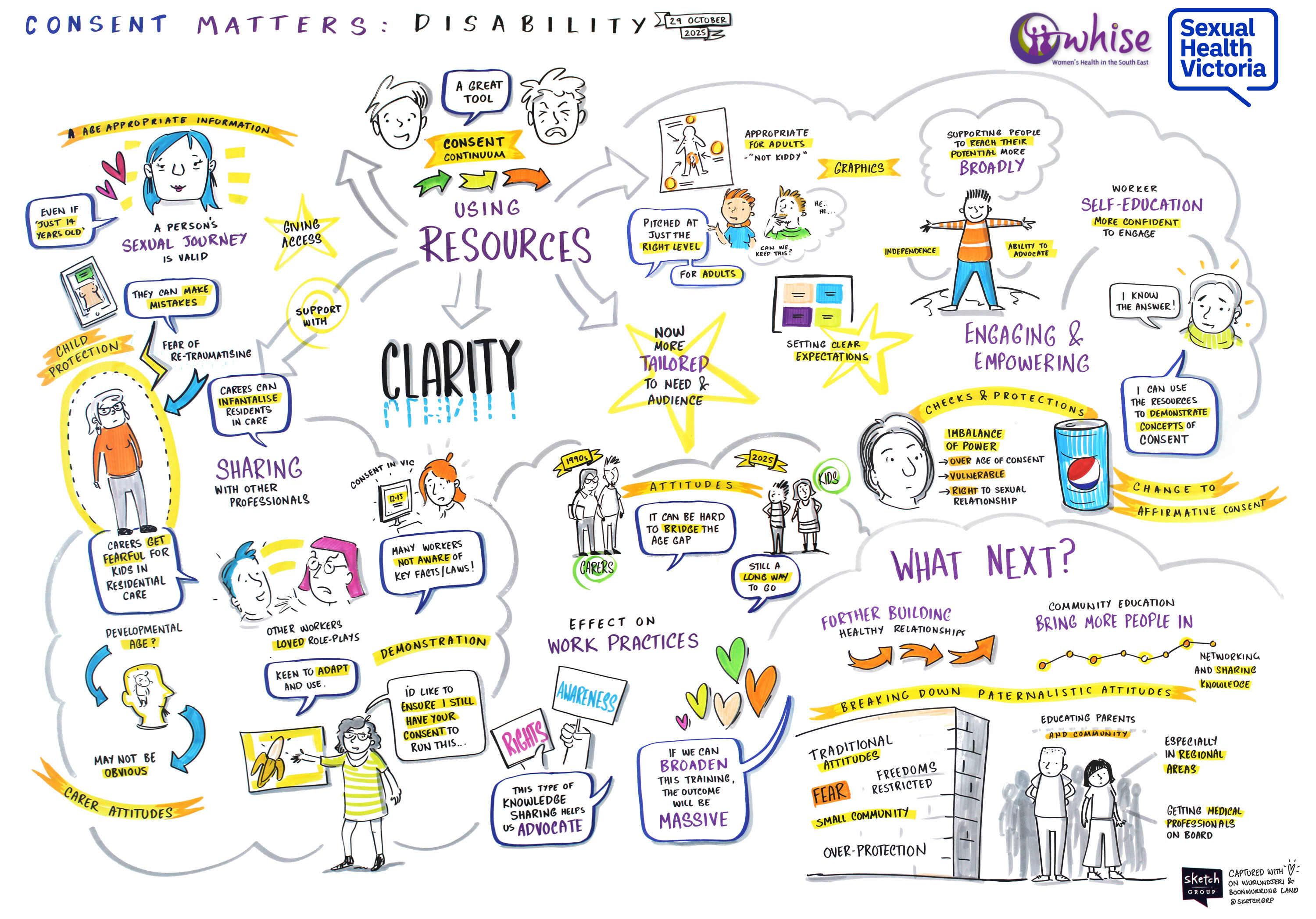
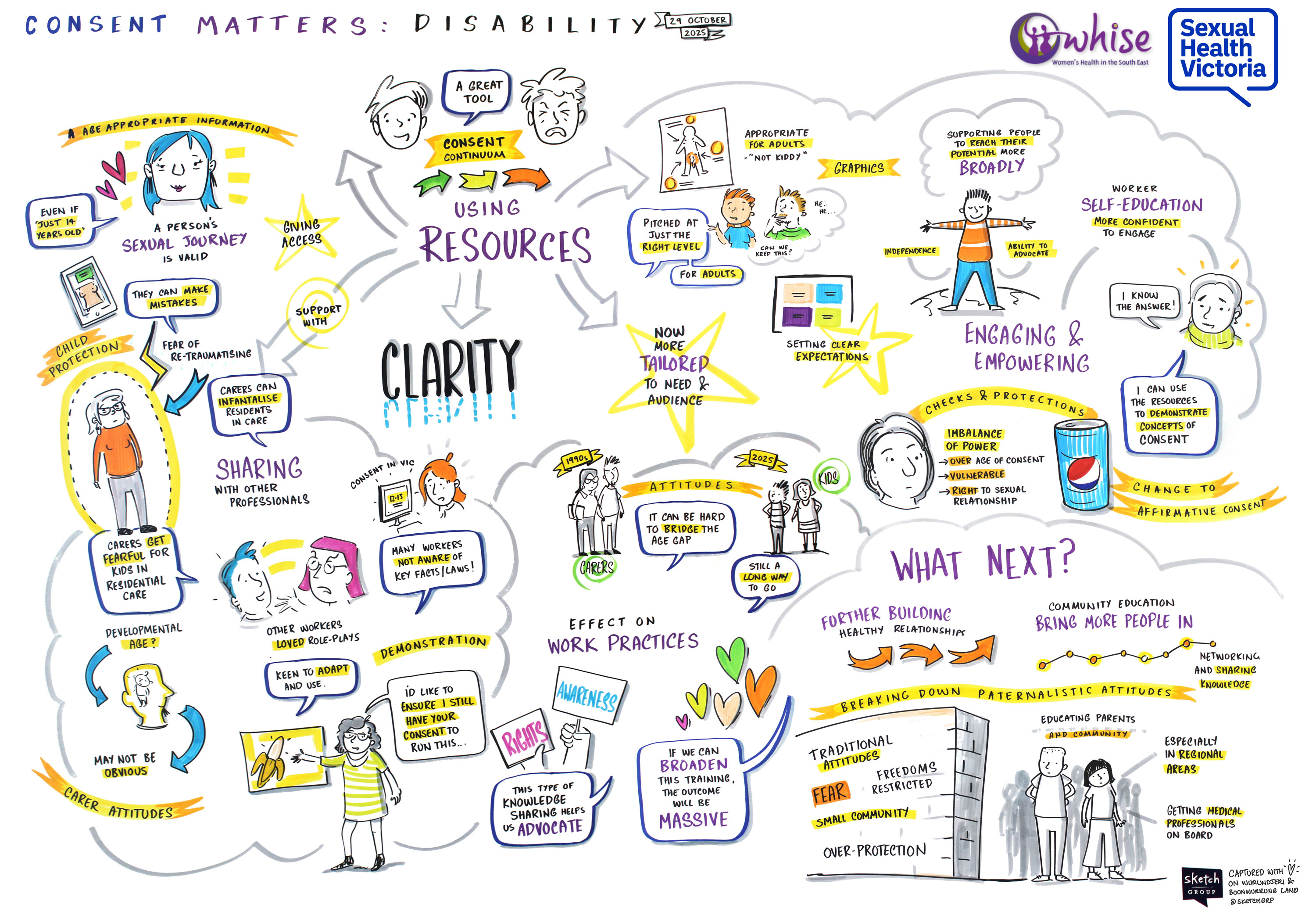
A focus group was held as part of this evaluation, bringing together participants from both metropolitan and regional areas. The Sketch Group produced a graphic recording, illustrating participants' reflections on the program's early influence on staff and workplace culture. Participants also discussed the ongoing challenges of discussing consent with young people with cognitive disability, as well as their plans to embed the program more deeply into professional practice.
Please refer to Consent Matters Disability Evaluation report for further reading of this project.